




Online advice about engineered stone is confused in both directions. A large Australian trade website's 2026 benchtop cost guide still describes engineered stone as a normal choice. Some quote sites say none can be installed anywhere in Australia. Neither is quite right, and the difference matters when you're choosing the most-used surface in the house.
This guide covers the engineered stone ban alternatives for benchtops, then the other finishes that decide how a renovation looks and wears over the next 15 years: floors, bathroom tiles, cladding and colour.
What exactly did the engineered stone ban change?
From 1 July 2024, in every state and territory, it became an offence for a business to make, supply, cut or install engineered stone benchtops, panels or slabs. Importing them has been banned since 1 January 2025, and the Australian Border Force has warned that rebranding a product to dodge the ban will be acted on.
Under the definition Safe Work Australia publishes, a product is engineered stone only if it meets all three tests:
- It contains at least 1% crystalline silica by weight.
- It's made by combining natural stone materials with other ingredients, such as water, resins or pigments.
- It hardens.
And it has to be a benchtop, panel or slab. So these are not banned:
- porcelain and sintered stone that contain no resin
- stone-look products with less than 1% crystalline silica
- concrete, bricks, pavers, ceramic tiles, roof tiles, grout, render and plasterboard
- finished products such as kitchen sinks
A product sold as "low silica" is only outside the ban if it's under 1%. Ask the supplier for the safety data sheet, which shows the crystalline silica content and whether the product contains resin.
If you already have engineered stone benchtops, they can stay. Removing, repairing or slightly modifying them is still allowed, but the business doing it has to notify the safety regulator and control the dust. The risk with any stone is in cutting and grinding, not in living with a finished bench.
What are the engineered stone ban alternatives for benchtops?
The best one matches how you cook and how much upkeep you'll accept. The options compare like this, with indicative costs from industry and quote-site guides published in 2026. They're not Sydney quotes, and slab size, edges, cut-outs and access all change the price.
| Material | Strengths | Weaknesses | Indicative cost (2026) |
|---|---|---|---|
| Laminate | Cheapest, wide range, no sealing | Not heat-resistant, swells if water gets into the joins | About $150 to $400 per m² installed |
| Timber | Warm, can be sanded and refinished | Needs oiling about once a year, stains, needs care near the sink | About $400 to $900 per m² installed |
| Low-silica engineered stone (under 1%) | Consistent look, non-porous, no sealing | Not fully heat-proof, edges can chip | About $450 to $1,000 or more per m², supply only |
| Granite | Excellent heat resistance | Sealing every one to two years, heavy | About $600 to $1,200 per m² installed |
| Marble | Unique veining | Soft, etches and stains, sealing yearly | About $800 to $2,000 per m² installed |
| Porcelain or sintered stone (no resin) | Excellent heat resistance, no sealing, thin and light | Chips at edges can't be invisibly repaired | About $900 to $1,800 per m² installed |
| Solid surface | Invisible joins, moulded sinks, scratches sand out | Poor heat and scratch resistance | About $700 to $1,400 per lineal metre installed |
| Stainless steel | Hygienic, heat-resistant, durable | Scratches, shows fingerprints | About $900 to $1,500 per m² |
Two cost points owners don't expect. Stone is bought by the whole slab, so a layout that runs just past one slab's yield costs a second slab. And there's a minimum charge for any stone job, because of the template visit, workshop time and install crew, even for a small vanity.
A practical approach is to put the expensive surface where it's seen and used most, such as the island or the main vanity, and a hard-wearing cheaper one in the laundry or butler's pantry. Decide before the joinery is drawn, because the slab size sets where the joins fall.
What does a benchtop really cost over 15 years?
More than the first price, for some materials. Add the upkeep to the purchase:
| Surface | Upkeep | When it's damaged |
|---|---|---|
| Laminate | None | Replace |
| Timber | Oil about once a year | Sand and re-oil |
| Granite | Seal every one to two years | Repair chips |
| Marble | Seal about once a year | Etching stays without re-honing |
| Porcelain | None | Chips can't be invisibly mended |
| Solid surface | None | Scratches and burns sand out |
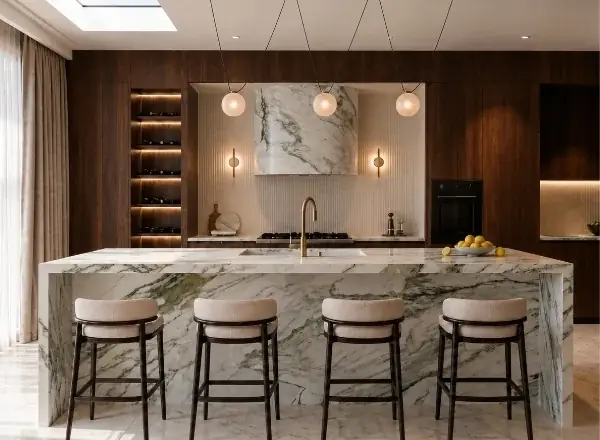
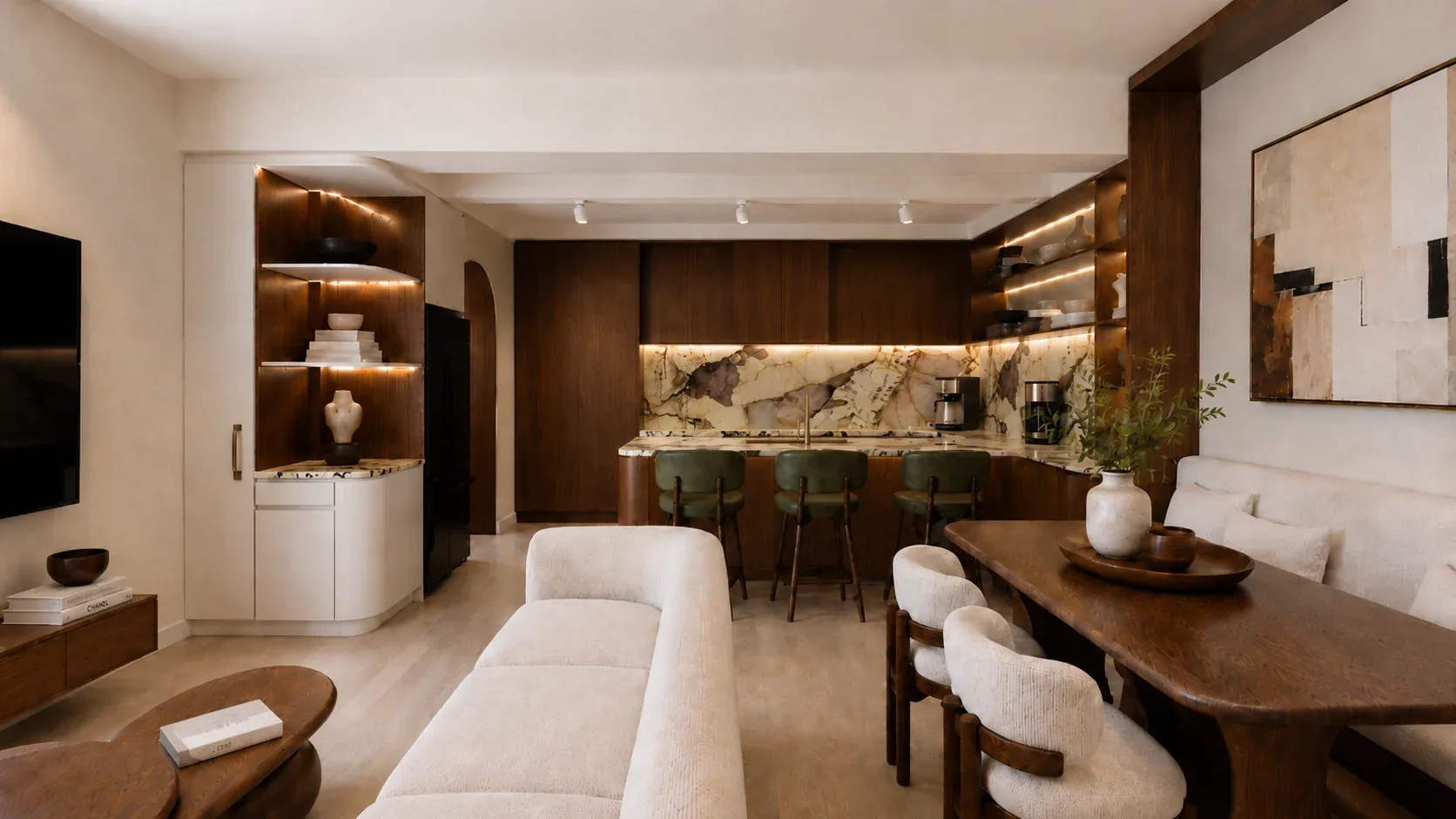
Take a 6 m² benchtop. In marble at about $800 per m² installed, it costs around $4,800 and asks for roughly 15 sealings over 15 years. In porcelain at about $900 per m², it's around $5,400 with no sealing, but a chipped edge stays visible. Which is cheaper depends on how the kitchen is used. At Amara in Leichhardt, warm walnut joinery meets veined marble in a kitchen made for gathering: a choice for a household that accepts the care marble needs.
Which floor suits a family home?
Start with three questions: can it be renewed, how does it handle water, and what does it cost to lay. A Sydney flooring cost guide, updated in October 2026, gives these supplied-and-installed figures:
| Floor | Typical Sydney cost per m² (2026) | Range |
|---|---|---|
| Laminate | $75 | $57 to $115 |
| Vinyl plank | $86 | $57 to $115 |
| Hybrid | $92 | $63 to $140 |
| Floor tiles | $150 | $92 to $230 |
| Engineered timber | $160 | $125 to $230 |
| Solid hardwood | $230 | $170 to $320 |
The same guide lists the extras: levelling the subfloor at $23 to $105 per m², removing the old floor at $9 to $29 per m², and sanding and polishing timber at $34 to $80 per m².
So hybrid flooring costs a little over half as much as engineered timber to lay in Sydney. The difference is renewal. Solid timber, and engineered boards with a thick enough top layer, can be sanded and recoated when they wear. Hybrid, vinyl and laminate are generally replaced instead. For a home you'll stay in for 15 years with kids and a dog, that changes the sums.
Two layout points matter as much as the material. One floor running through the living areas makes a small house feel larger, as our small house guide explains. And in a duplex or townhouse with rooms above rooms, hard floors carry footstep noise, so plan the underlay and the ceiling insulation below.
What slip rating do bathroom tiles need?
For a house, the building code sets slip ratings only for stairs, landings and ramps: P3 or R10 on dry stair treads and P4 or R11 where they get wet. It doesn't set one for bathroom floors. Tile industry advice, published by a major tile retailer, suggests P3 or above for bathrooms, kitchens and laundries, and P4 or P5 outdoors and around pools.
Shower floors bring another rule. The building code requires the floor of a shower to fall to the waste at between 1:80 and 1:50. Large-format tiles are hard to lay to those falls around a single central waste. A linear strip drain, or a fall in one direction, makes big tiles work. So choose the drain before you choose the floor tile.
In a small bathroom, a few habits help:
- Fewer grout lines read calmer and clean faster. Mid-tone grout hides wear better than white.
- One feature per small room. A patterned floor, or a feature wall, or coloured grout, but not all three.
- Run wall tiles to a clear line, full height or to the top of the shower screen, and start the setting-out from the edge you see first.
- Order spares from the same batch and keep a box for repairs. Tile batches vary in colour.
How do you choose a colour scheme in Sydney light?
Most paint advice online is written for the northern hemisphere, and it's backwards here. In the UK, north-facing rooms are the dark, cool ones. In Sydney the sun is to the north, as the Australian Government's Your Home guide explains, so north-facing rooms get the most sun and south-facing rooms get cooler, indirect light. Dulux Australia suggests colours with a high light reflectance for south-facing rooms.
Light reflectance value (LRV) measures how much light a colour reflects, from 0 for black to 100 for a perfect white. It helps in both directions. Wattyl suggests an exterior white with an LRV of 85 or less, because brighter whites can be glary in full sun.
A method that works:
- Start with what you can't change: the floor, the benchtop, the brick, the roof, the view and the light.
- Choose one main wall colour for each zone and one or two accents. Check the undertone against the fixed materials, for example a warmer white beside oak and marble, a cooler one beside grey porcelain.
- Paint large samples, A4 or bigger, on two walls, one in sun and one in shade, and look at them in the morning, the afternoon and at night under your own lights.
- Check exterior colours in full sun from the street, with the roof and fence colours beside them.
Your roof colour may already be decided. In NSW, the BASIX certificate can commit a renovation or new home to a roof colour range, measured by how much sun it absorbs. Switching to a darker roof later can break that commitment, so check the certificate first.
Can you change colours in a heritage conservation area?
Usually yes, but the brick is a different matter. The City of Sydney's repainting guidelines say you don't need permission to repaint in a conservation area, unless the building is a heritage item or in Millers Point or Dawes Point. They also say to repaint only surfaces that were meant to be painted, and not to paint face brick, tiles or stone.
Inner West's proposed new development control plan, exhibited in 2026, says the same about face brick: don't paint or render original face brick and other unpainted elements. It asks for traditional colour schemes and low-sheen finishes on street-facing facades, based on evidence such as paint scrapes and old photos, or on typical schemes for the period. Until it takes effect, the former Leichhardt, Marrickville and Ashfield controls apply.
Painting face brick is the change these rules care most about, and it's hard to undo. At Everleigh, a Victorian terrace in Balmain, the facade was restored and recycled brick ties the old and new parts of the house together. Our heritage conservation area guide explains how these areas work.
What about external cladding?
Brick, render, fibre cement, timber weatherboards and metal each trade first cost against upkeep: timber and render need repainting cycles, face brick needs very little. In a heritage conservation area, keep original materials as they were meant to be, including unpainted face brick, natural stone and decorative timber or iron. Bushfire-prone land and walls close to a boundary bring their own limits, so check those with your certifier early.
What do owners most often regret?
Choosing finishes before the layout works, and leaving selections open. A 2018 Houzz Australia article on renovation regrets put "poor floor plans" near the top of its list, with owners focusing on colour and finish instead. A Sydney builder posting on a renovation forum made the same point: most variations during a build come from selections and materials, so settle them before the build starts. Our design to budget guide covers how to lock selections in before tender.
What this means for you
Before you choose finishes:
- For any stone-look benchtop, get the safety data sheet showing silica content and whether it contains resin
- Decide which surfaces need to be the hardest-wearing, and spend there
- Price benchtops on the full slab, after the joinery layout is drawn
- Compare floors on 15-year cost, including sanding or replacement
- Choose the shower drain before the floor tile
- Ask for P3 or better on bathroom, kitchen and laundry floors
- Test paint colours in large samples, in your own light, morning to night
- Check your BASIX certificate for a roof colour commitment
- In a heritage area, leave face brick unpainted and check the colour rules
- Settle every selection before the build is priced
Our feasibility study tests what your budget buys before design starts, and our work on renovations and extensions includes choosing materials with you. If you're thinking of buying materials from overseas, read our guide to importing building materials first.
Questions people ask
Is engineered stone banned in NSW?
Yes. Since 1 July 2024, it has been illegal everywhere in Australia, including NSW, for a business to make, supply, cut or install engineered stone benchtops, panels or slabs containing 1% or more crystalline silica. Importing them has been banned since 1 January 2025. Porcelain and sintered stone without resin, and products under 1% silica, are not covered by the ban.
Can I keep my existing engineered stone benchtop?
Yes. The ban stops new engineered stone from being supplied and installed. Existing benchtops can stay, and they can be removed, repaired or slightly modified, but the business doing that work has to notify the safety regulator and control the dust. If you're renovating, ask your builder how they'll handle it.
Is hybrid flooring cheaper than engineered timber?
Yes, to lay. A Sydney flooring cost guide updated in October 2026 puts hybrid at a typical $92 per m² installed and engineered timber at $160. Engineered timber with a thick enough top layer can be sanded and recoated when it wears, for about $34 to $80 per m², while hybrid is generally replaced. Over 15 years in a busy home, the gap can narrow.
Why does my paint colour look different on the wall?
Because the light is different. A chip seen under shop lights isn't the same as a wall in your south-facing room in winter or under warm downlights at night. In Sydney, north-facing rooms get direct sun and south-facing rooms get cooler, indirect light. Paint large samples on two walls and look at them at different times of day.
Sources
- Engineered stone ban, Safe Work Australia
- Australia's engineered stone import laws are changing, Australian Border Force (December 2024)
- Benchtop costs in Australia: complete guide 2026, Three Birds Renovations
- Benchtops in South Australia 2026, The Quote Yard
- Flooring cost Sydney 2026, What's The Damage (October 2026)
- NCC 2022 Housing Provisions, Part 10.2 Wet area waterproofing, Australian Building Codes Board
- Orientation, Your Home, Australian Government
- Roof colour and solar absorptance, NSW Planning Portal (February 2026)
- Heritage conservation areas: repainting guidelines, City of Sydney
- Draft Inner West DCP, Part 2 Heritage, Inner West Council