



Most people start with a price per square metre, because that's the number fit-out companies publish. It's a useful first figure when you're working out a café fit-out cost in Sydney, but on its own it can be a long way from what your shop will cost. At the ranges published in 2026, an 80 m² café could cost anywhere from about $120,000 to $400,000 or more. Where yours lands has little to do with the tiles. It depends on whether the exhaust can reach the roof, where a grease trap can go and whether the switchboard is big enough, and on how many weeks of rent you pay before the first customer walks in.
This guide takes the budget apart, so you can see which pieces a builder's quote covers and which ones land on you.
Why can't anyone give you a straight price per square metre?
A rate per square metre is an average of other people's projects. It quietly assumes a typical shop: drainage near the kitchen, a clear path for the exhaust, enough power, a level floor. Your site may have none of those.
The things that move the price most come with the building you choose:
Existing Shell
A former café may already have a grease trap, floor wastes and an exhaust riser you can reuse, if they're approved and in good order. A bare shell has none of them, so each one has to be added and paid for.
Where the Services Can Run
A kitchen at the back of a ground-floor shop with a rear lane is a fairly simple job. A kitchen under three storeys of apartments may need an exhaust riser up the full height of the building, which costs more and needs the landlord's agreement.
Floor Levels
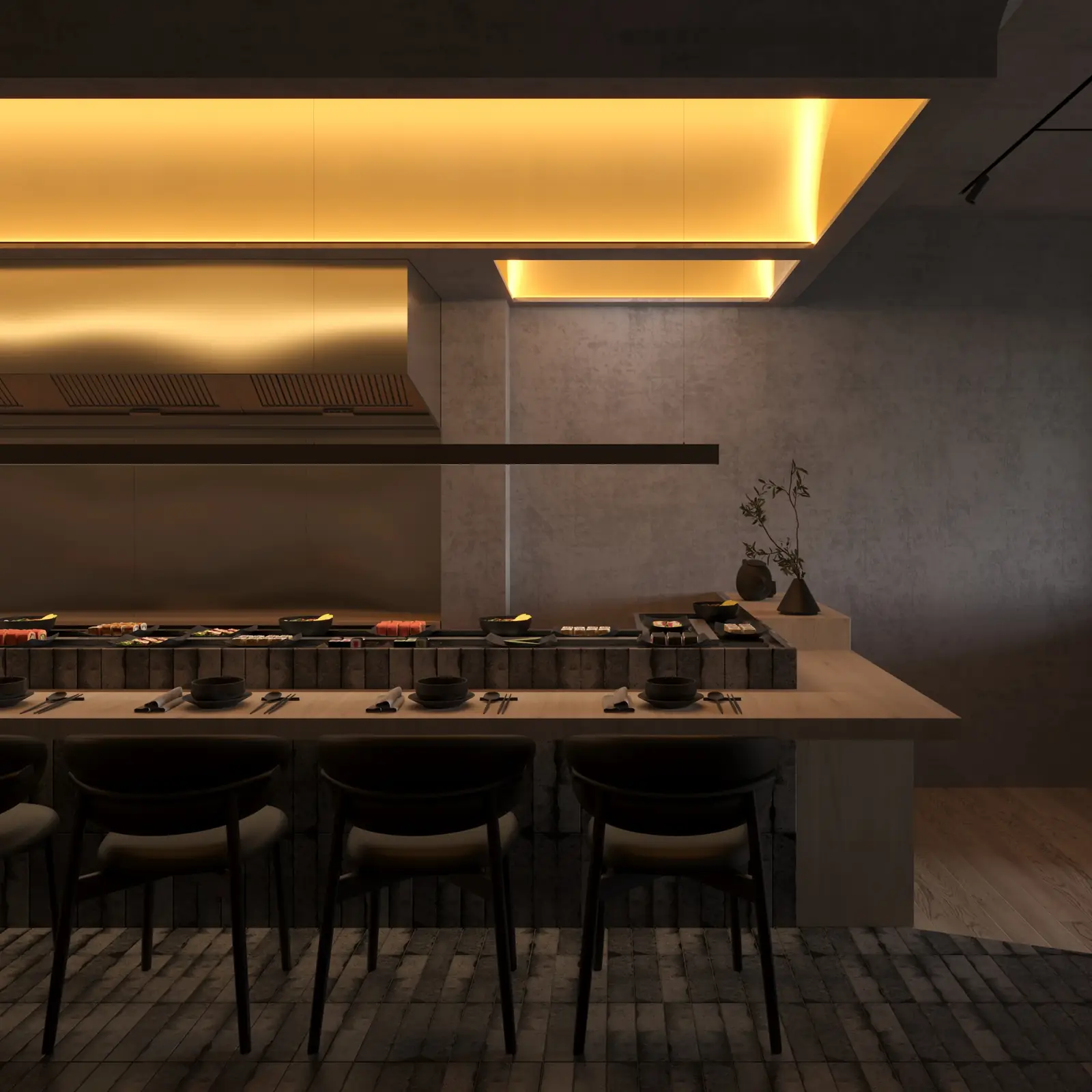
Level changes across a floor affect access for customers and how easily the fit-out can be built. At Sushi Train Rose Bay, we turned the level changes into raised platform seating.
What the Landlord Hands Over
Some shops come with services ready to connect. Others are an empty concrete box, and every service has to be brought in.
Ask for prices once you have a layout. These costs depend on where the kitchen, toilets and services go, so a quote given without a plan has to include a generous allowance for what the builder can't see yet.
What does a café fit-out cost in Sydney in 2026?
These are published industry ranges, not quotes. Neither source says whether its figures include GST, and both come from the fit-out market, so treat them as a starting point.
| What's being priced | Indicative range | Source and year |
|---|---|---|
| Basic refresh, Sydney | $1,500 to $2,200 per m² | A Sydney hospitality fit-out builder's published estimator, 2026 |
| Standard fit-out, Sydney | $2,500 to $4,000 per m² | Same estimator, 2026 |
| Premium fit-out, Sydney | $4,500 per m² and up | Same estimator, 2026 |
| Basic refit, Australia-wide | $1,500 to $3,000 per m² | HospitalityHub cost guide, July 2026 |
| Standard build, Australia-wide | $3,000 to $5,000 per m² | HospitalityHub, July 2026 |
| Large or specialised kitchen, Australia-wide | $5,000 to $8,000 per m² or more | HospitalityHub, July 2026 |
| Small café, total | $100,000 to $350,000 | HospitalityHub, July 2026 |
| Mid-size restaurant or bar, total | $350,000 to $800,000 | HospitalityHub, July 2026 |
For an 80 m² café, the standard Sydney band works out at roughly $200,000 to $320,000. The cost of a restaurant fit-out in NSW follows the same logic, with the kitchen pushing it up: more cooking means more exhaust, refrigeration and power. Both figures come before the items below that often sit outside a builder's price.
Where does the money actually go?
In our experience, when a fit-out budget goes wrong, the cause is usually the services: the parts you can't see once the café opens, and the ones that councils, Sydney Water and the building code all have rules about.
Kitchen exhaust
The City of Sydney requires that a commercial kitchen exhaust "must discharge vertically above the roof level" without affecting neighbours. Other councils set their own conditions. In a single-storey shop that may be a short duct. Under apartments, it can mean a riser up the full height of the building, which needs the landlord's agreement. One Australia-wide guide from 2026 puts exhaust and ventilation at $8,000 to $40,000 or more. The menu drives all of this, so decide what you'll cook before anyone draws the kitchen.
Grease trap and plumbing
Sydney Water is direct: "If you cook or serve hot food, you must have a grease trap and a trade waste agreement with us." Its 2025 plumbing guide sets a minimum size of 1,000 litres and requires a licensed plumber. It asks for a metre of clear space above the trap for servicing, and written approval before you start trading. Kitchen wastewater should reach the trap by gravity. In the City of Sydney, the trap can't sit in a kitchen, food preparation or food storage area.
So a tank of at least 1,000 litres has to fit near your tenancy, outside the kitchen, with drains that fall towards it. That's why two shops that look alike can have very different plumbing bills. The same 2026 guide puts gas and plumbing at $5,000 to $25,000, without breaking out the grease trap.
Power, gas and air-conditioning
A coffee machine, oven, dishwasher and fridges running together draw a lot of power, and an older shop's switchboard may not be sized for it. A Sydney hospitality builder's 2026 estimator lists landlord switchboard upgrades among the base-building works it leaves out, alongside structural changes and sewer or grease line connections. Ask who pays for each before you sign. Kitchens also add heat, so the air-conditioning works harder than it would in a shop.
Toilets
The City of Sydney asks for staff toilets with hand basins, and customer toilets "if the venue holds more than 20 diners". Other councils have their own thresholds. Either way, settle your seat numbers early, because they decide how many toilets you need and where the plumbing has to go.
Equipment
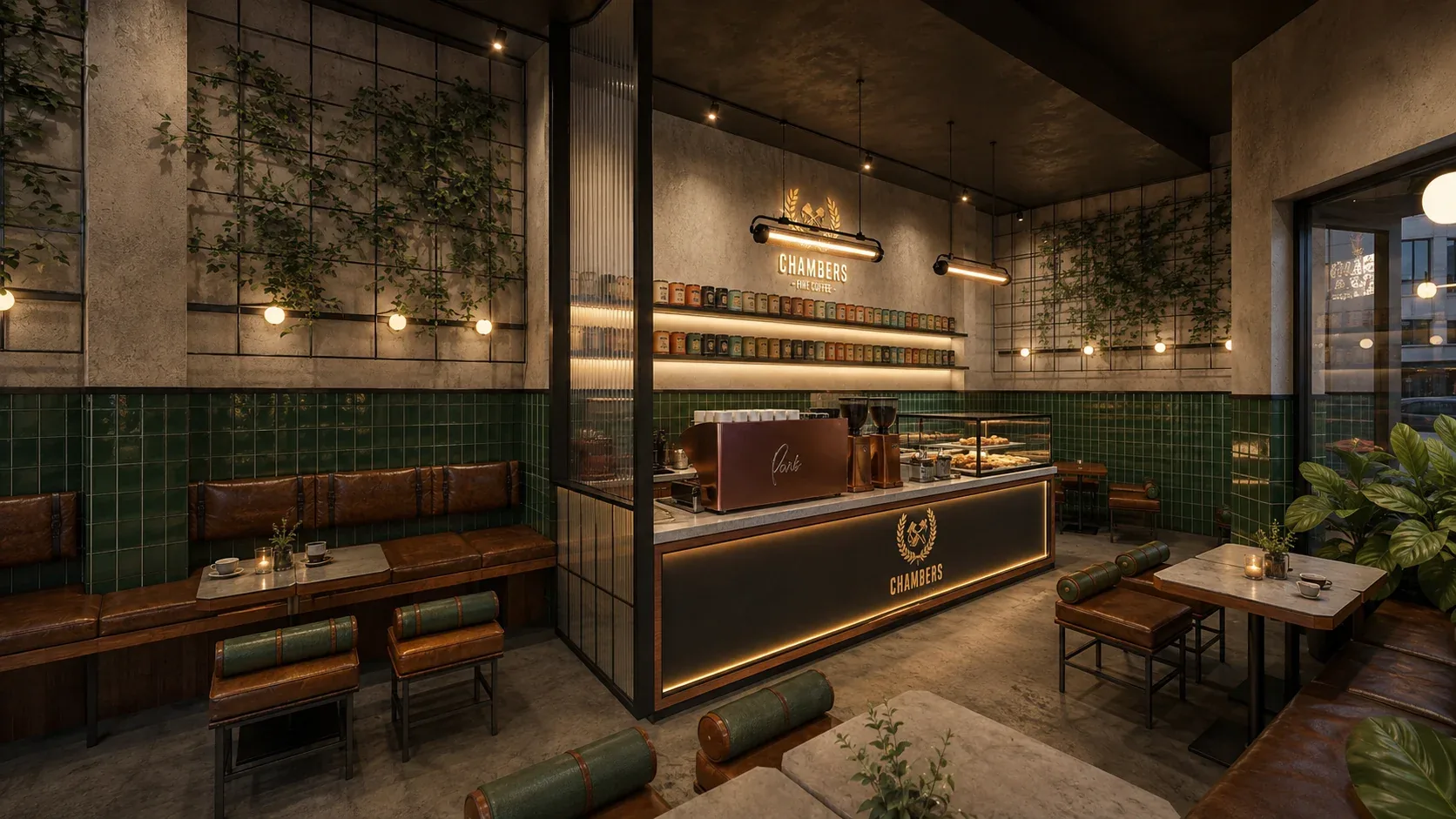
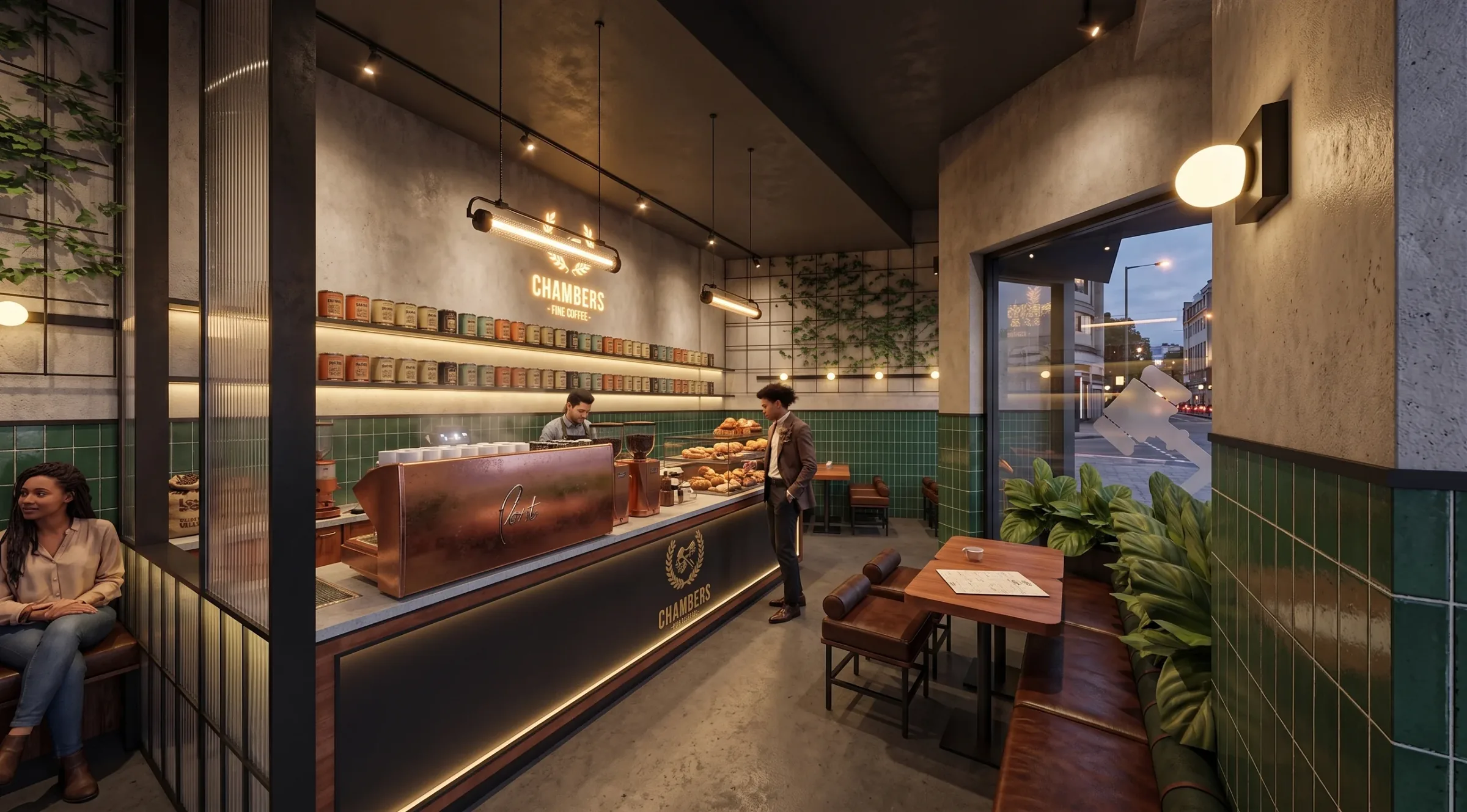
The 2026 guide estimates equipment at 40 to 60% of a typical fit-out budget, with cooking equipment at $15,000 to $80,000 or more and refrigeration at $10,000 to $60,000 or more. Some builders include equipment; many price only the connections. At Chambers Cafe, even the coffee machine was chosen to suit the palette. Choose your equipment during design, so the layout, power and plumbing can be planned around it.
What's usually left out of a builder's quote?
A builder's quote covers only what's listed in it, and budgets usually go over on the items that aren't. One Sydney hospitality builder's online estimator sets out clearly what it leaves out, and its list makes a good checklist. Ask every builder whether their price includes:
- Council and certifier fees, which are paid to the authority, not the builder
- Base-building work: structural changes, sewer or grease line connections, switchboard upgrades
- Asbestos or other hazardous material removal, and demolition nobody expected
- Kitchen equipment and refrigeration, or only the connections
- Furniture, crockery, uniforms, opening stock and smallwares
- Liquor, food and outdoor dining approvals
- Point-of-sale hardware and software
- Signage, and any approval it needs
- Consultants' reports, such as mechanical, hydraulic, structural or acoustic
- A contingency, and the rules for spending it
Three costs are never in a builder's quote, because they sit between you and the landlord: rent and outgoings during the build, the bond or bank guarantee, and make good when you leave.
How much are council and authority fees?
Council and authority fees are usually a small part of the budget. The bigger costs around approvals are the specialist reports and the rent you pay while you wait for a decision.
| Item | Who charges it | Indicative amount | Source |
|---|---|---|---|
| Development application fee | Council | Maximum $852 on works estimated at $150,000; $1,216 at $250,000 (cost including GST) | NSW planning fees schedule, 2026/27 |
| Notifying neighbours, if council requires it | Council | Up to $1,532 | NSW planning fees schedule, 2026/27 |
| Long service levy | Long Service Corporation | 0.25% of works costing $250,000 or more, including GST; $625 on $250,000 | NSW Government |
| Development contribution (section 7.12) | Council, where it has a plan | A fixed percentage of the cost; the standard maximum is 1% | NSW Planning circular PS 21-003, 2021 |
| Trade waste approval | Sydney Water | Set out on Sydney Water's fees page | Sydney Water, 2025 |
| Specialist reports | Consultants | Design and consultant fees together: about $20,000 for a typical fit-out with a CDC, up to $30,000 with a DA | OIC |
The long service levy has to be paid before building work starts. A section 7.12 contribution applies only if your council has a contributions plan, and that plan sets the rate and any threshold. In the City of Sydney, food businesses also register with council before trading, and the unannounced inspections that follow each carry a fee.
Design and approvals versus the build: how do they compare?
Design is a small part of the budget next to construction, but it decides most of the other costs. Where the kitchen sits, for example, sets how far the drainage and exhaust have to run. For the approval side, see can this shop become a café?
When a design-and-construct company does the design, its cost sits inside the build price. The Sydney estimator quoted above lists design, 3D renders, construction documentation and coordination of DA or CDC approvals within its estimate. With an independent designer, you see the fee on its own. For restaurant interior design, our fees page sets out what each stage includes. We explain the trade-off in what "free" fit-out design does and doesn't include.
You pay for design either way. The difference is who the designer answers to, and whether three builders can price the same drawings. At Luana Hair & Beauty in Waterloo, a budget-conscious salon, raised platforms let the hair-washing area work without major changes to the existing floor and plumbing. A design decision like that can save more on the build than it adds to the design fee.
What about rent, the bond and the cost of leaving?
These costs sit outside the builder's price, and you need the cash for each of them.
Rent During the Build
The shop isn't trading during the fit-out, so make sure you can afford the rent for those weeks, or negotiate a rent-free period with the landlord.
Landlord's Works
If you're paying towards the landlord's work to prepare the shop, a retail lease requires the maximum cost to be agreed in writing before the lease begins. You don't pay more than that amount.
Bond or Bank Guarantee
Expect the landlord to ask for a cash bond, a bank guarantee or a personal guarantee. If you pay a cash bond on a retail lease, the landlord must lodge it with the NSW Small Business Commission.
Make Good When You Leave
Make good is what it costs to return the shop at the end of the lease. It can mean stripping it back to a bare shell and repainting. Agree the make-good standard before you sign, and record the shop's condition at the start. It's also worth asking for a clause that lets an independent quantity surveyor settle the cost if you can't agree. Price it now, while you can still negotiate.
Is the price with or without GST?
Check every number. GST is 10%, and a business registered for GST can generally claim back the GST in the price of things it buys for the business. You still need the cash on the day you pay. Council's DA fee and the long service levy are both worked out on the cost of works including GST. Mixing ex-GST and inc-GST quotes is the quickest way to misread a comparison.
How much should you hold back for surprises?
Hold back more in an old building than in a new one. Asbestos, hidden drainage and a tired floor often only show up once the old fit-out comes out. The Sydney estimator mentioned above has its contingency switched off by default, and still recommends you carry one. Agree in advance who can authorise spending it.
What this means for you
- Before you sign the lease, find out what the shell can carry. Look for an exhaust path to the roof, a place for a 1,000 litre grease trap outside the kitchen, enough switchboard capacity, and approvals that cover what you plan. Our before you sign the lease check looks at exactly this, with a rough budget range and questions for the landlord.
- Get a layout drawn before you ask for quotes, so every builder prices the same kitchen, toilets and services.
- Build the budget in four parts: design and approvals; the build; equipment, furniture and opening stock; occupancy costs such as rent during the build, the bond and make good. The budget worksheet below follows that order.
- Ask every builder to price the same drawings and to list their exclusions.
- Put the money questions in the lease: the rent-free period, the cap on landlord's works, and the make-good standard.
If you haven't settled on the shop yet, start with our checklist for before you sign the lease. Once you have, see how we approach café and restaurant design, or book a free 15-minute call.
Questions people ask
How much does it cost to fit out a small café in Sydney?
Industry guides published in 2026 put a small café at roughly $100,000 to $350,000, or about $1,500 to $5,000 per square metre depending on the finish and the kitchen. A former café with reusable services sits towards the bottom; a bare shell towards the top. Equipment, rent during the build and council fees can sit outside those figures, so check what each quote includes.
Is it cheaper to take over a shop that was already a café?
Often, if the exhaust, grease trap and drainage are approved, working and where your layout needs them. That's a lot of ifs. Ask council for the existing consent and its conditions, such as trading hours and seat numbers, and have the services checked before you rely on them. A former café with the kitchen in the wrong place can cost as much as a bare shell.
Will the landlord pay for any of the fit-out?
Sometimes, as a negotiated incentive such as a rent-free period or a contribution to the works. The NSW Small Business Commissioner notes that the tenant is usually responsible for the fit-out, and suggests negotiating a rent-free period to cover the build. Whatever you agree, put it in the lease, including the most you'll pay towards the landlord's own works.
Are council fees a big part of the budget?
Usually not. For 2026/27 the maximum DA fee on works estimated at $250,000 is $1,216. The long service levy is 0.25% on works of $250,000 or more, and a section 7.12 contribution, where it applies, is typically up to 1%. The bigger costs around approvals are specialist reports and the rent you pay while you wait.
Why are two builders' quotes so different?
Usually because they're pricing different things. One includes equipment and the other doesn't. One assumes the existing grease trap works; the other allows for a new one. Ask both to price the same drawings and list their exclusions. On a bigger job, the NSW Small Business Commissioner suggests it may be worth having an independent certified quantity surveyor check the costs.
Sources
- Schedule of planning and development fees and charges 2026/27, NSW Department of Planning, Housing and Infrastructure
- About the long service levy for the building and construction industry, NSW Government
- Planning circular PS 21-003: Increasing section 7.12 levies, NSW Department of Planning, 2021
- Plumbing for retail food businesses, Sydney Water, November 2025
- Get approval for a food business, City of Sydney
- Understanding the costs of leasing, NSW Small Business Commissioner
- Fit-outs: who pays?, NSW Small Business Commissioner
- Register for goods and services tax (GST), business.gov.au
- Café and restaurant fit-out estimator published by a Sydney hospitality shopfitter, 2026
- Hospitality fit-out costs in Australia 2026, HospitalityHub, July 2026