




A shop and a café can look identical from the street. In NSW planning law they're different uses, and moving from one to the other is a change of use, which needs approval. It doesn't always mean a full development application: if the site and the design fit the state's standards, a certifier can approve it much faster. The route you end up on decides your timeline, your fees and sometimes your menu, so it's worth knowing before you sign anything.
What is a change of use?
Planning law sorts businesses into defined uses: shop, office premises, business premises, food and drink premises, and so on. A change of use application asks for approval to use premises for a different one of those purposes. It's about what happens inside the premises, so it can apply even if you don't touch a wall.
Some changes need no approval at all. Under NSW planning rules, certain groups of uses can switch between each other as exempt development, provided the standards are met, and shops, office premises and business premises sit in the same group. A change from one type of retail shop to another counts as a change of tenant, so there's no change of use. A shoe shop becoming a gift shop is simply a new tenant.
A café is different. NSW planning defines food and drink premises as premises used for "the preparation and retail sale of food, drink, or both, for immediate consumption on or off the premises", and that group isn't on the exempt list. That's why a shop becoming a café needs approval, even when the building stays the same.
Can I turn a shop into a café in NSW?
Usually, yes, with planning approval. There are two ways to get it:
- a development application (DA) to council, assessed on its merits, or
- a complying development certificate (CDC) from a private certifier or council, if the site and the proposal meet every standard in the state's complying development rules.
Before either, check that the zone allows a café. Council's local environmental plan must show restaurants and cafes, or food and drink premises, as permitted with consent in the land use table for your zone. If the zone prohibits food and drink premises, neither route is open, and it's time to look at another shop. A planning certificate from council shows the zone and what it allows.
When can a change of use be a CDC instead of a DA?
A change of use can be a CDC when the site is eligible and the design meets every standard. If even one standard isn't met, the café needs a DA instead. These are the main tests and what they mean for a café:
| Test | What it means for a café |
|---|---|
| Zone | The premises must be in an employment, mixed-use or special purpose zone. |
| Local plan | A café must be permitted on the site under council's local environmental plan. |
| The land | Not available on land with certain constraints, such as a heritage item or a high-risk bushfire area. |
| Patron numbers | The 2023 NSW guide caps patron capacity at 100, and an older fact sheet gave a 50-seat limit, so confirm the current figure with your certifier. |
| Kitchen standard | The fit-out must follow AS 4674-2004, the Australian Standard for the design, construction and fit-out of food premises. |
| Cooking | No barbecue or charcoal cooking. |
| Exhaust | New mechanical ventilation: no higher than 1 m above a pitched roof or 3 m above a flat roof, set back more than 3.5 m behind the building line, and not in a heritage conservation area. |
| Shopfront | An upgrade can't reduce the glazing, and isn't allowed this way in a heritage conservation area. |
| Building code | The work must meet the relevant Building Code of Australia requirements. |
| Previous use | The previous use must have been lawful, and the café must follow the conditions of the most recent council approval (hours, noise, parking, waste and so on). |
| Other approvals | Not available if the proposal needs concurrence from another agency, is designated development or needs an environment protection licence. |
Two practical points. First, the fit-out work and the change of use can go in together in a single complying development application. Second, if the shop is in a heritage conservation area, look hard at the exhaust and shopfront rows. A new exhaust or shopfront there can't go through as complying development, and on an older high street that alone can turn a café into a DA.
When is a DA the only route?
A DA is needed whenever one of the standards above can't be met. Typical reasons for a café are:
- the site is a heritage item, or the exhaust or shopfront work is in a heritage conservation area
- you want more patrons than the CDC cap, or a charcoal grill
- you want different conditions from the existing consent, such as later trading hours
- the previous use wasn't lawfully approved, or the premises relies on existing use rights
A DA can still get you the café you want. Council assesses it on its merits, so a proposal that doesn't tick every box can still be approved. It takes longer and needs more documents, and council can attach its own conditions.
What does council ask for with a change-of-use DA?
Each council publishes its own list, so check yours. City of Sydney's list for "fit out and use as a food and drink premises" gives a fair picture of what to expect:
- a statement of environmental effects, which every DA needs, along with the plans and documents the NSW Planning Portal asks for
- the estimated cost of the development
- a waste and recycling management plan
- a plan of management if the venue is licensed or open after 10pm
- an acoustic report for the development types in council's list, such as venues with amplified music or a large patron capacity
- a heritage impact statement if the site is a heritage item or in a heritage conservation area
- a Building Code of Australia (BCA) report, which City of Sydney asks for on DAs that propose a change of use
Behind those documents are the questions council is really asking. Will the exhaust bother the neighbours? Where do the bins go, and how do deliveries work? What are the hours? Can the building be used safely for the new purpose? A clear answer to each, on the drawings, is what keeps an application from stalling.
What does a café fit-out have to include?
The food rules apply whichever approval route you take. Every food business must meet the national food standard for premises and equipment (Standard 3.2.3). The Australian Standard for food premises fit-outs, AS 4674-2004, is usually a condition of a council development consent, and premises approved as complying development must meet it too.
In practice, that means items most shops don't have:
| Item | What's required |
|---|---|
| Hand basins | Within 5 m of where food is handled, with hands-free warm water through a single spout |
| Walls | Solid construction: "stud walls are not permitted" |
| Pipes and conduits | Concealed in floors, plinths, walls or ceilings, or kept clear of them |
| Sinks | A double-bowl sink (or single bowl plus dishwasher), a food preparation sink and a separate cleaner's sink |
| Floors | Impenetrable, drained to the sewer and graded to a floor waste; timber and polished concrete generally not suitable in kitchens |
| Grease trap | If you cook or serve hot food, a grease trap of at least 1,000 litres and a trade waste agreement |
| Exhaust | Discharging vertically above the roof level |
| Toilets | Staff toilets, and customer toilets if the venue holds more than 20 diners |
Several of these details come from City of Sydney, and other councils set similar requirements, so check what applies to your shop. For a shop conversion, the costly items are the ones that involve drainage and the roof: the grease trap, the floor wastes and the exhaust.
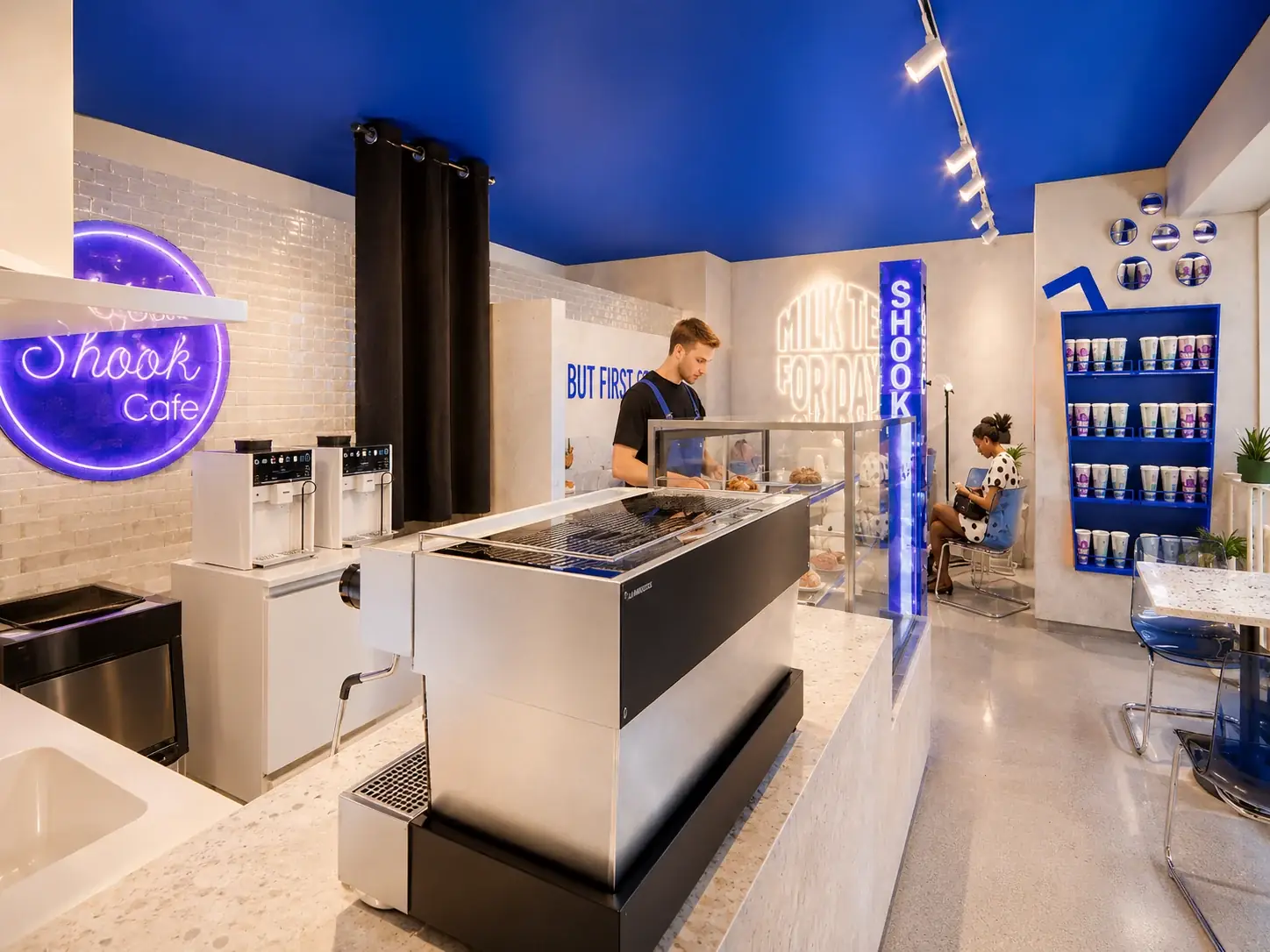
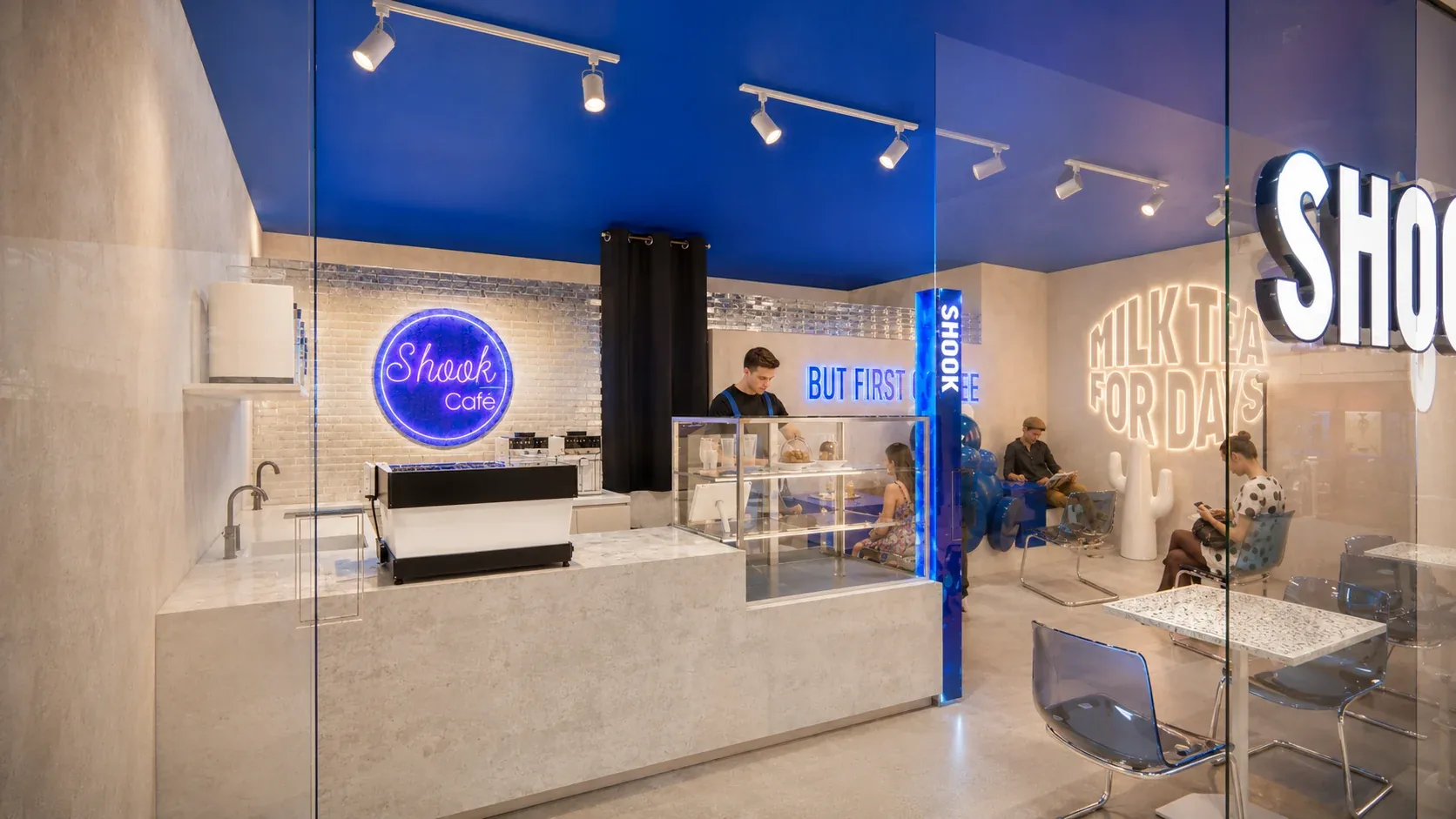
Fitting all of this into a small tenancy without the café feeling like a corridor is most of the design work. At Shook Cafe in Waterloo, the brief needed a clear separation between front of house and back of house without making a compact space feel enclosed. At Harry's House, a dessert shop in Bankstown, we drew the seating towards the shopfront so the small tenancy draws people in.
How long does a change of use take?
It depends almost entirely on the route.
The CDC Route
A CDC can be approved in as little as 10 to 20 days once the application is complete and every standard is met.
The DA Route
A DA takes longer. Across NSW, the average assessment time had fallen to 84 days by mid-2026, and the state expects councils to decide DAs within an average of 90 days of lodgement, a target that will shorten over the next few years. The count runs from lodgement to decision and includes any time council waits for more information from you, so a complete application saves time.
Either way, design comes before lodgement, and on a DA a construction certificate, the build, final inspections and registration come after. Our realistic timeline from lease to first customer shows how the stages add up, including the averages for Inner West, City of Sydney and other councils.
What does a change of use cost in council fees?
Council DA fees in NSW follow a state scale based on the estimated cost of the work. The maximum fees for 2026/27 are:
| Estimated cost of the work (including GST) | DA fee, 2026/27 maximum |
|---|---|
| No building work (a change of use only) | $395 |
| $5,001 to $50,000 | $235, plus $3.00 for each $1,000 over $5,000 |
| $50,001 to $250,000 | $488, plus $3.64 for each $1,000 over $50,000 |
| $250,001 to $500,000 | $1,608, plus $2.34 for each $1,000 over $250,000 |
| $500,001 to $1 million | $2,420, plus $1.64 for each $1,000 over $500,000 |
So a café fit-out estimated at $150,000 would attract a DA fee of up to $852: $488, plus 100 lots of $3.64. If council's community participation plan requires your DA to be notified, there's a further fee of up to $1,532. Each council publishes the fees it actually charges and invoices them when the application is lodged.
Council fees are rarely the big number. The larger costs are the drawings and reports behind the application: plans, the statement of environmental effects, and any BCA, acoustic or waste reports. On a CDC, the certifier sets its own fee, so ask for a written quote.
What this means for you
If you want to turn a shop into a café, work through these in order before you commit:
- Get a planning certificate and confirm the zone allows food and drink premises with consent.
- Ask council for the current development consent and read its conditions.
- Test the CDC standards against the site, including the zone, heritage, patron numbers, cooking type and exhaust position.
- Walk the shop to check the exhaust route, a place for the grease trap, the toilets, drainage and power.
- Only then put numbers on the fit-out and the approval, and compare the budget and timing with the lease.
Our before you sign the lease check covers this ground for one specific site. You receive a written summary with the likely approval route, the red flags and a rough budget range. For the lease side of the same decision, see our checklist before you sign the lease.
If you go ahead, the approval (change of use, DA or CDC for the fit-out) is part of every commercial fitout we take on. We measure the site, design the café, prepare the drawings, manage the application and coordinate with your builder. Our café and restaurant design page explains how a project runs.
And if your change is from one kind of shop to another, or between shop, office and business premises with no real building work, you may not need planning approval or a designer at all. Check the exempt development standards on the NSW Planning Portal first.
Questions people ask
What is a change of use application?
It's an application for planning approval to use premises for a different purpose from the one approved, for example a shop becoming a café. In NSW it's lodged through the NSW Planning Portal, either as a DA to council or as a CDC to a private certifier or council. It can include the fit-out work in the same application. It doesn't cover separate permissions such as a liquor licence, outdoor dining or Sydney Water's trade waste agreement, which each have their own process.
Do I need council approval for a café if the shop already has a kitchen?
Usually yes, unless the premises already has consent for a use like yours. A kitchen left behind by a previous tenant isn't the same as an approval for your café. Ask council for the current development consent and check what it describes and what conditions it sets. If it already covers a café like yours, you may only need approval for new building work, or none if the work is exempt. You'll still need to register your food business with council before you trade.
Is a CDC always better than a DA?
A CDC is faster when the café fits the standards: it can be approved in as little as 20 days. But a CDC only works if the proposal meets every standard, and bending a design to fit them can cost you seats, the cooking you wanted or a better exhaust position. A well-prepared DA for the café you actually want can be the better result. We recommend testing both routes against the site before choosing one.
Does a change of use mean upgrading the whole building?
Not automatically, but it can trigger work. City of Sydney asks for a Building Code of Australia report with DAs that propose a change of use. A new use can bring different requirements for fire safety, exits, access and toilets. How much applies depends on the building and the extent of your work. A certifier or building code consultant can tell you early what the change is likely to trigger, and that answer belongs in your budget before you sign.
Sources
- Change of use (exempt development), NSW Planning Portal
- Complying Development for Business and Industry: A Pocket Guide (May 2023), NSW Department of Planning and Environment
- Setting up a restaurant or cafe: rules for exempt and complying development (fact sheet, 2020), NSW Department of Planning
- Complying development, NSW Department of Planning
- Cafés, restaurants and retail outlets, NSW Food Authority
- Get approval for a food business, City of Sydney
- Check document requirements for a development application, City of Sydney
- Plumbing for retail food businesses (version 3, November 2025), Sydney Water
- Statement of Expectations Order, NSW Department of Planning
- Schedule of planning and development fees and charges for 2026/27, NSW Department of Planning, Housing and Infrastructure